I recently conducted a study analyzing 168 restaurants on Google Maps in Sheikh Zayed, Egypt. I wanted to compare the top 20 highest ranking restaurants against the bottom 20 to find out what actually moves the needle.
No theories or guesswork. This is real data pulled from a well-known tool that scrapes Google Business profiles.
In this article, I'll break down the key findings from this study and show you exactly what the best-performing restaurants are doing differently – so you can apply the same tactics to your own local business.
Before we dive into the findings, let me put this into perspective.
According to Google, "near me" searches have grown by over 500% in recent years. When someone searches for "restaurants near me" or "best Italian restaurant in Sheikh Zayed," they're not casually browsing; they're ready to make a decision.
The restaurants that show up in the local map pack (the top 3 results) capture the lion's share of clicks and foot traffic. The ones buried below? They might as well not exist.
I've seen this play out with my own clients. In one seo case study for an Egyptian small business, we helped a dentist in Sheikh Zayed increase quarterly bookings from 51 to 114 clients in just 12 months – primarily by dominating Google Maps for "dentist near me" searches.
The same principles apply to restaurants. So let's get into what actually works.
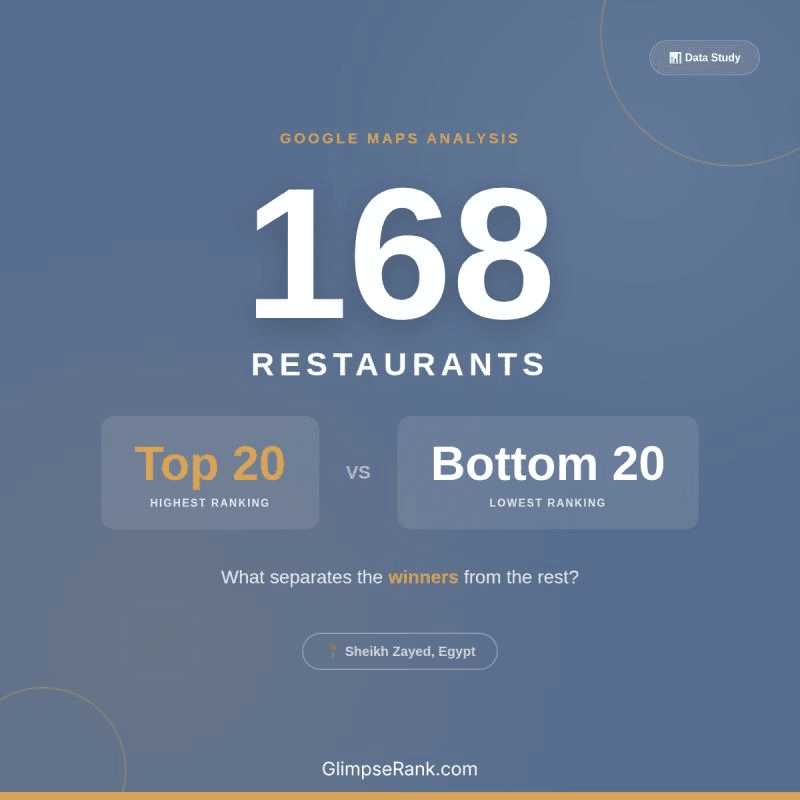
I pulled data on 168 restaurants in Sheikh Zayed and ranked them by their Google Maps visibility. Then, I isolated the top 20 performers and the bottom 20 and compared them across several key factors.
Here's what the data revealed.
Let's start with something painfully basic yet surprisingly overlooked.
90% of top-ranking restaurants have claimed and verified their Google Business Profiles.
Only 35% of the bottom-ranking ones have.
That's it. That's the gap at the most fundamental level.
If your Google Business Profile isn't verified, you're not just invisible – you're vulnerable. Anyone can submit edits to your listing. Your business hours? Changed. Your phone number? Gone. Your business name? Hijacked.
I've seen it happen to real businesses.
Verification isn't a "nice to have." It's the bare minimum before anything else matters. If you haven't done this yet, stop reading and go verify your profile now. Everything else I'm about to share is meaningless without it.
Here's what most people already know: more reviews = higher rankings.
But the data tells a more nuanced story.
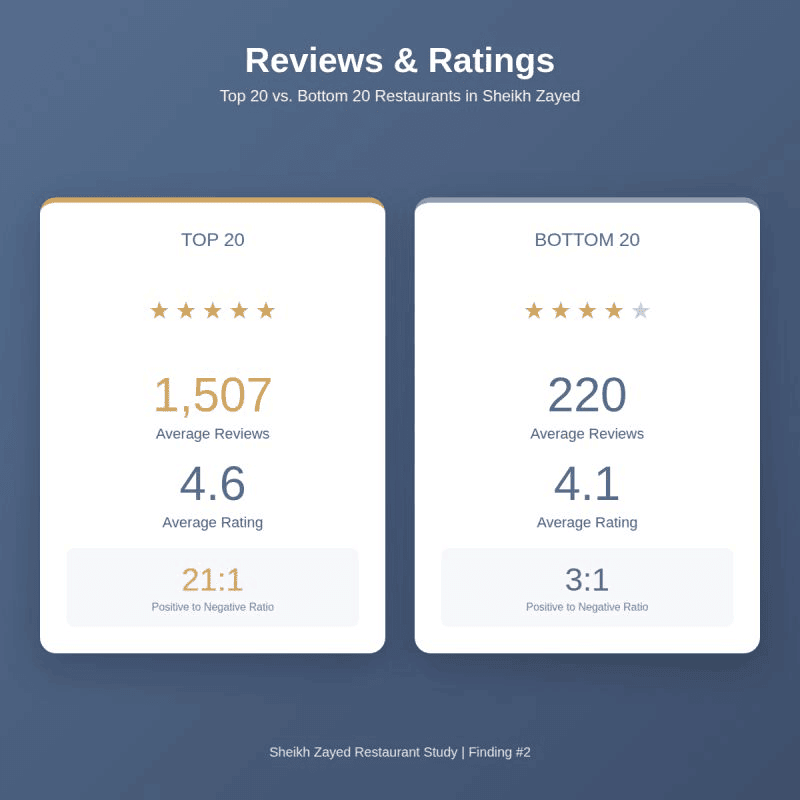
The top 20 restaurants average 1,507 reviews.
The bottom 20 average just 220 reviews.
That's nearly 7x more reviews for the top performers.
But it's not just about quantity. It's about the ratio. Here's the finding that surprised me:
The top 20 restaurants have a 21:1 ratio of positive ratings (5-star and 4-star) to negative ratings (3-star, 2-star, and 1-star).
In other words, for every bad review, they've got 21 happy customers burying it.
The bottom 20? That ratio drops to 3:1.
One angry customer and suddenly your rating tanks.
The average ratings tell the same story:
Half a star might not sound like much. But when someone's hungry and scrolling through options, that half star is the difference between "let's try this place" and "keep scrolling."
The lesson here isn't just "get more reviews" (you already knew that).
It's this: Volume protects you. A steady stream of positive reviews doesn't just boost your visibility – it shields your rating from the inevitable occasional bad experience. One negative review hurts a lot less when you have 1,500 positive ones backing you up.
Actionable tips:
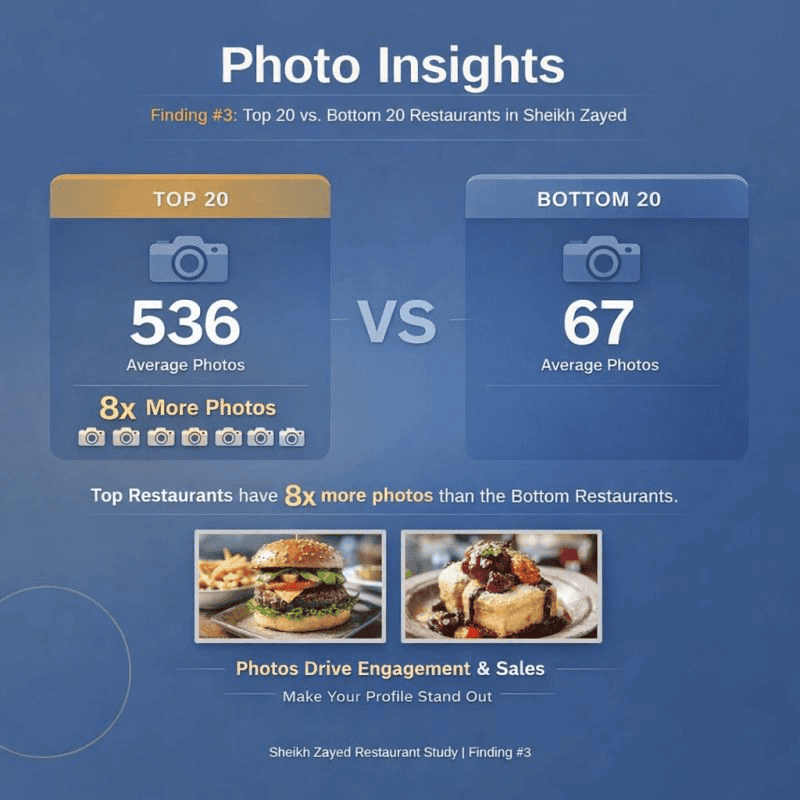
In an industry like F&B, photos are king. People eat with their eyes first.
The top 20 restaurants average 536 photos on their Google Business Profiles.
The bottom 20? Just 67 photos.
That's 8x more photos for the top performers.
A mouth-watering photo of your signature dish does more selling than any description ever could. But here's the thing – you don't have to do all the heavy lifting yourself.
Ideas to keep your profile active and your photo count growing:
The goal isn't just aesthetics. It's activity. There's a clear pattern: Google rewards profiles that stay fresh and updated. A dormant profile signals a dormant business.
I honestly can't believe business owners are still missing this.
19 out of 20 top-ranking restaurants have their business hours filled in.
9 out of 20 bottom-ranking restaurants don't.
It literally takes 2 minutes to fill in your business hours, yet the impact on your Google Business Profile ranking is HUGE.
In fact, business hours and profile completeness are among the top 5 GBP ranking factors according to the 2026 Whitespark Local Search Ranking Factors report.
What you need to complete:
Businesses shouldn't expect to be rewarded for not adding the bare minimum details to their profile. Google wants to serve its users the most complete, accurate information – and it ranks businesses accordingly.
Here's the thing about local SEO for restaurants (and any local business, really): the fundamentals matter more than any fancy tactic.
If I had to summarize this entire study in one sentence, it would be this:
The top-performing restaurants on Google Maps are doing the basics exceptionally well, consistently, over time.
They've verified their profiles. They've completed every field. They're actively generating reviews. They're uploading fresh photos regularly. They're engaging with customers.
There's no secret hack here. Just relentless execution of the fundamentals.
These Google Business Profile optimizations are just one piece of the puzzle. A complete local SEO strategy also includes:
I've written extensively about how these elements work together in my local SEO case study where we achieved a 2.23x growth in bookings for a dental practice using this exact framework.
The same principles apply whether you're running a restaurant, a clinic, a retail store, or any other local business.
Here's something many local business owners aren't thinking about yet: AI assistants like ChatGPT are increasingly being used to discover local businesses.
When someone asks ChatGPT "What are the best restaurants in Sheikh Zayed?", the AI pulls from various data sources – including Google Maps data and reviews.
Businesses with strong Google Business Profiles, lots of positive reviews, and comprehensive information are more likely to be recommended by AI assistants. This is a trend that's only going to accelerate.
If you want to stay ahead of this curve, check out my article on how to help ChatGPT discover your products or services.
The results in this study weren't a stroke of luck – they reflect patterns I've seen repeatedly across 6+ years of working with local businesses in Egypt.
Whether you run a restaurant, retail store, clinic, or any other local business, the fundamentals of Google Maps optimization remain the same.
Want to know where your business stands?
I'm offering a free Google Maps audit for local businesses in Egypt. I'll analyze your Google Business Profile, compare it against your top competitors, and give you a prioritized action plan – no strings attached.
Reach out to get started:
📱 Phone/WhatsApp: +201005264979
✉️ Email: [email protected]