Let me be blunt with you: posting on Instagram and hoping for the best is not a marketing strategy.
The most common complaint I hear from restaurant owners in Egypt is some version of "we're spending money on ads but not seeing results." More often than not, the issue isn't the budget; it's where and how that budget is being spent.
In this article, I'll walk you through three digital marketing strategies that I genuinely believe every restaurant owner in Egypt should be using in 2026. No fluff, no jargon. Just practical advice you can act on.
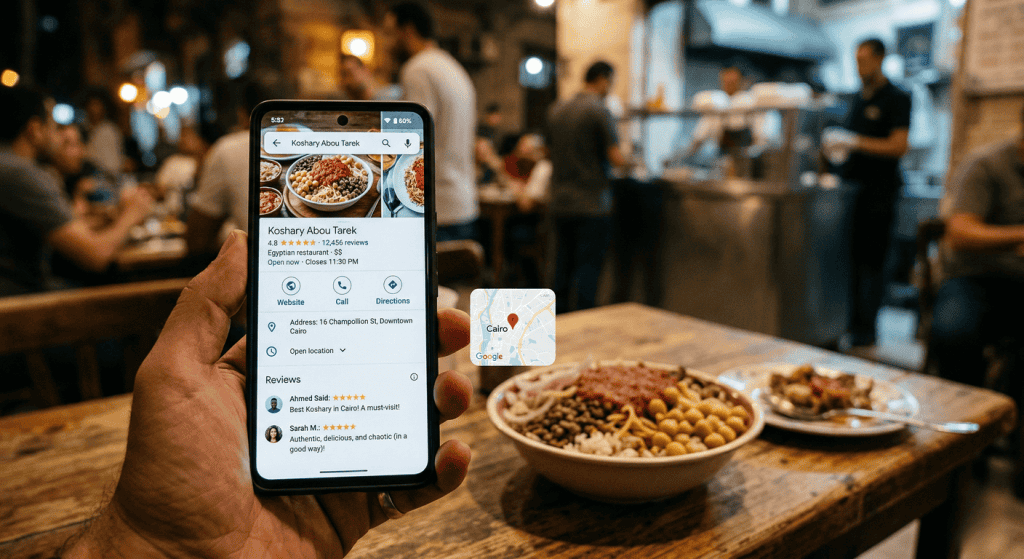
Before we talk about spending a single pound on ads, let's make sure your free real estate on Google is fully optimized.
Your Google Business Profile (GBP) is the listing that appears when someone searches for your restaurant name — or something like "مطاعم قريبة مني" — on Google or Google Maps. If it's incomplete or inactive, you're handing customers over to your competitors on a silver platter.
Here's what a well-optimized GBP looks like:
Get the basics right. Make sure your primary category is set correctly (the more specific, the better, like "Italian restaurant" or "Seafood restaurant"). Add your correct working hours, your menu link if you have one, and at least 15–20 high-quality photos of your food, interior, and exterior. Google rewards active profiles. The more complete and updated yours is, the more likely it is to show up when someone nearby is hungry.
Post regularly. Most restaurant owners don't know that Google lets you post updates directly on your profile: promotions, new menu items, seasonal offers (I also highly recommend adding your social profile links to your Google Business Profile in their dedicated field). Think of it as a mini social media feed that shows up directly on Google. It signals to Google that your business is active, and it gives potential customers a reason to choose you.
Reviews are everything. A restaurant with 400 reviews at 4.5 stars will almost always outperform one with 50 reviews at 4.8 stars. Volume matters. The simplest way to build reviews? Train your waitstaff to ask happy customers right after a great meal, while the experience is fresh. A simple "We'd really appreciate it if you left us a review on Google" goes a long way. You can also place a small QR code on the table or on the receipt that links directly to your review page. Make it as frictionless as possible.
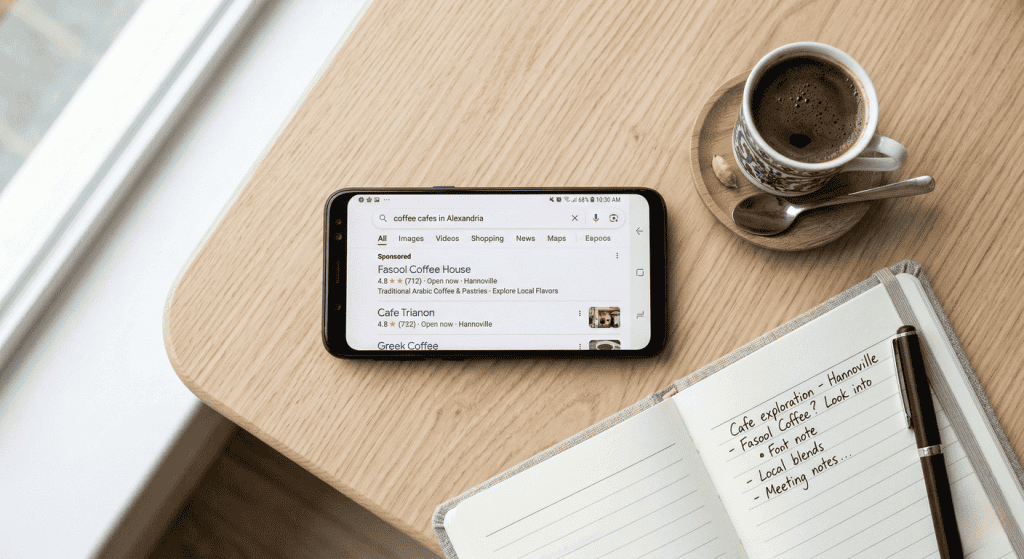
Here's what makes Google Ads so powerful for restaurants compared to most other platforms: you're not interrupting someone who is scrolling — you're showing up for someone who is actively searching.
Think about it. When someone types "restaurant near me" or "أفضل مطعم في الشيخ زايد" into Google, they're not browsing — they're deciding. That's the moment you want to show up.
With Google Ads, you can run ads on both Google Search and Google Maps, targeting people within a specific radius around your restaurant. So if your restaurant is in Maadi, you can make sure your ad only shows to people who are currently in or around Maadi and actively searching for a place to eat.
This type of hyper-local targeting is something we use regularly at Glimpse Rank, not just for restaurants but for local businesses across different industries — from dental clinics to retail stores. The principle is the same: show your business to the right person, in the right place, at the right moment.
One important thing to keep in mind: Google Ads require ongoing management and optimization to get a good return on your budget. Running a campaign without knowing what you're doing can drain your budget quickly without meaningful results. If you want to explore this, I'd recommend working with someone who has hands-on experience with local Google Ads campaigns.
While Google Ads capture demand that already exists, Meta Ads (Facebook and Instagram) are about creating demand — putting your restaurant in front of people who don't know you yet but are very likely to become regulars.
The real strength of Meta Ads for restaurants lies in the audience targeting. You can target people based on their interests (food lovers, foodies, people who follow competing restaurants), their location (within a specific distance from your branch), and even their behaviors. But the most powerful feature — in my opinion — is Lookalike Audiences.
Here's how it works in plain English: you give Meta a list of your existing customers (even just their phone numbers or emails), and Meta finds other people on the platform who share similar characteristics. You're essentially telling the algorithm, "find me more people like my best customers."
For a restaurant, this is gold. Instead of showing ads to a broad, unqualified audience, you're reaching people who are statistically likely to enjoy what you offer.
A few practical tips for Meta Ads specifically for restaurants:
My honest recommendation: start with your Google Business Profile since it costs nothing and the ROI can be immediate. Once that's in order, layer in Google Ads if you want faster results, and Meta Ads if you want to build a larger, loyal customer base over time.
The restaurants that are winning in Egypt right now aren't necessarily the ones with the biggest budgets. They're the ones showing up consistently in the right places online. If you want a deeper look at how SEO specifically can grow your restaurant, check out our SEO service for restaurants.
If you want to find out which of these strategies makes the most sense for your restaurant specifically, feel free to reach out directly:
📱 WhatsApp/Phone: +201005264979 ✉️ Email: [email protected]
I'll take a look at your current online presence and give you an honest assessment — no strings attached.